ok let's use this diagram to explain.
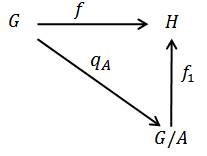
So, we start with $f:G\rightarrow H$, as shown by the top arrow. $f$ maps items from $G$ to $H$.
$f$ is surjective, could be injective or not.
$q_{a}:G\rightarrow G/A$, maps items from $G$ to its equivalence class in $G/A$
$f_{1}: G/A \rightarrow H$ maps the equivalence classes in $G/A$ to $H$. in this case, the equivalence classes in $G/A$ are the elements. equivalence classes aka cosets.
example (which i invented hehe, suppose all tans stays in the west, lees in the east, ngs in the south)
$G = \left \{ Tan Mark, Tan John, Lee Matthew, Ng Luke \right \}$
$H = \left \{ stay in the West, stay in the East, stay in the South \right \}$
$q_{a} = \left \{ surname Tan, surname Lee, surname Ng \right \}$
so under this map, $f:G\rightarrow H$, $f(Tan Mark)=stay in the West$, $f(Tan John)=stay in the West$, $f(Lee Matthew)=stays in the East$, $f(Ng Luke)=stays in the south$
then $q_{a}:G\rightarrow G/A$ maps each ppl to their surnames, i.e $q_{a}(Tan Mark) = surname Tan$, $q_{a}(Ng Luke) = surname Ng$ etc . this group is definitely surjective, because each element has to belong to some class, they all have a surname, so definitely surjective.
then $f_{1}: G/A \rightarrow H$ maps surnames to where they stay for eg. wah damn tiring to type all i v tired
but it's that simple, nothing tricky about it. as prof says, "the quotient map doesn't tell u much, plus, we're not even doing much to get it. it just falls out if you stay at it hard enough. "
well there's a little more group axioms in the quotient group itself too. and isomorphism. screw it, i lazy explain now *LOL* i'm so not a dedicated math blogger *LOL*

No comments:
Post a Comment